Speaking at OISD conference Oxford Brookes
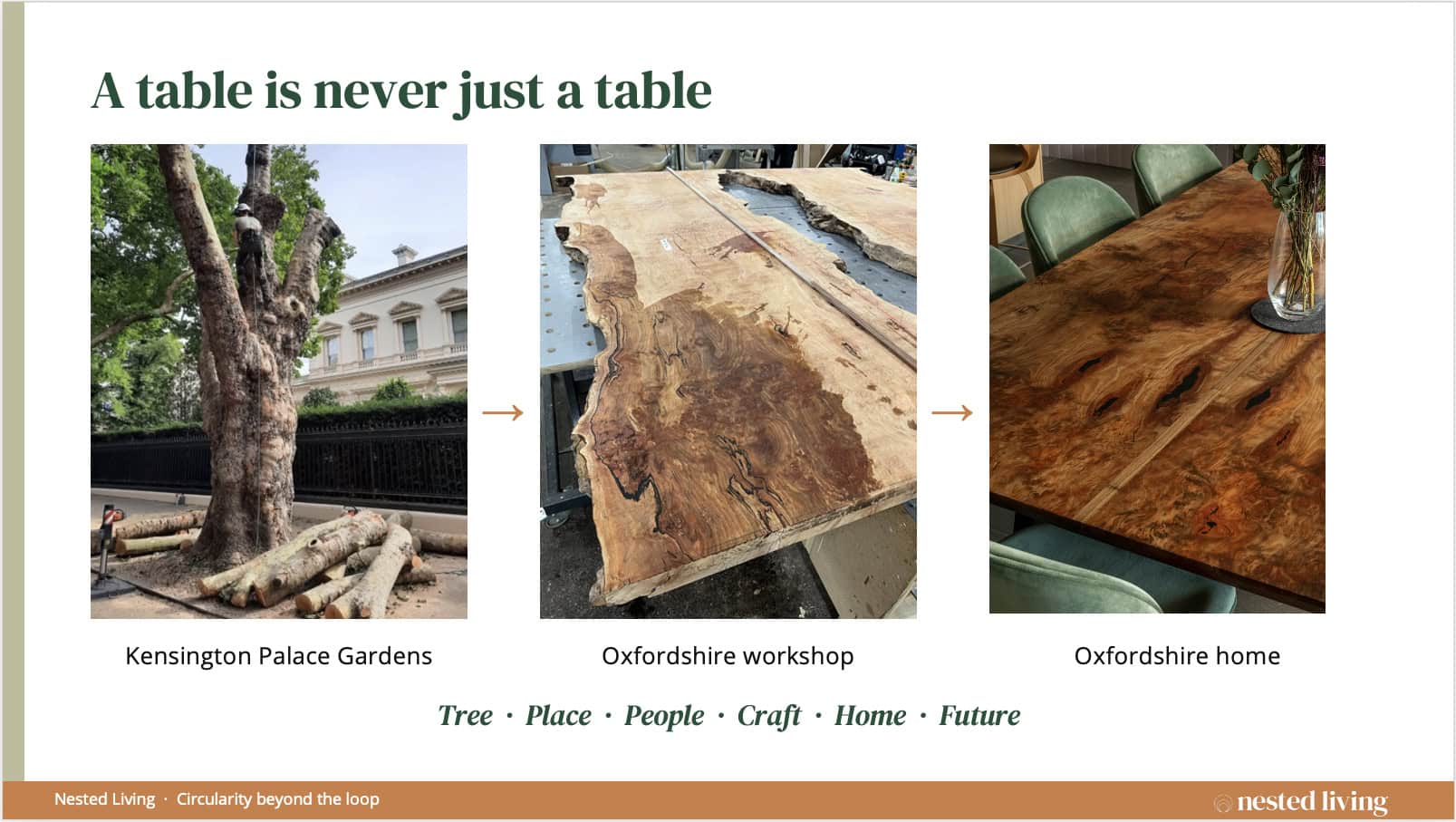
Helen, our co-founder, was invited to speak at the OISD Annual Conference at Oxford Brookes University on Friday, exploring innovation for a sustainable built environment.
Her talk, Circularity Beyond the Loop, started with a question: what if closing the loop isn’t actually the end goal?
Circularity is an important part of how we work at Nested Living, retaining value, designing out waste and enabling materials and products to be repaired, adapted, reused and kept in circulation. But a loop doesn’t close itself. It depends on the relationships, skills, infrastructure and places around it.
Helen explored what happens when we widen the lens: what is the loop nested within, and what does closing that loop make possible? Can the choices we make not only reduce impact, but develop the capacity of people, places and the wider living systems we’re part of to adapt and flourish?
That wider view connected with many of the conversations across the afternoon, from how we turn research and innovation into real-world change, to climate adaptation, overheating, health, building performance and adaptive reuse.
Overheating was a recurring theme, including through several of the MSc student studies looking at the issue in different building contexts. The Climate Change Committee warns that, without additional adaptation, 92% of existing UK homes could be at risk of overheating by 2050.
We also heard about HEARTH – the National Hub on Net Zero, Health and Extreme Heat — and its systems-thinking, people-centred approach to climate, buildings, health and vulnerability. A building doesn’t experience these things in isolation. Decisions around energy efficiency, overheating, ventilation and indoor air quality can have consequences for health and comfort. It would be good to see more of this whole-systems thinking applied across the built environment.
Helen also joined the closing panel on knowledge exchange and real-world impact. The discussion raised some very practical questions around how good ideas actually make their way into practice. Funding can be difficult to access, particularly for small businesses where match-funding requirements can make grants unaffordable. Earlier collaboration matters, as does better communication and easier connections between universities, practice, industry, local authorities and communities.
There is no shortage of research, knowledge or ideas. The challenge is creating the conditions that allow them to develop, be tested and make their way into practice.
Many thanks to Esra Kurul for the invitation and Rajat Gupta and the OISD team for bringing together such a broad range of research, practice and perspectives.