MA Regenerative Architecture Oxford Brookes
Storying Place: Listening to the Earth Trust
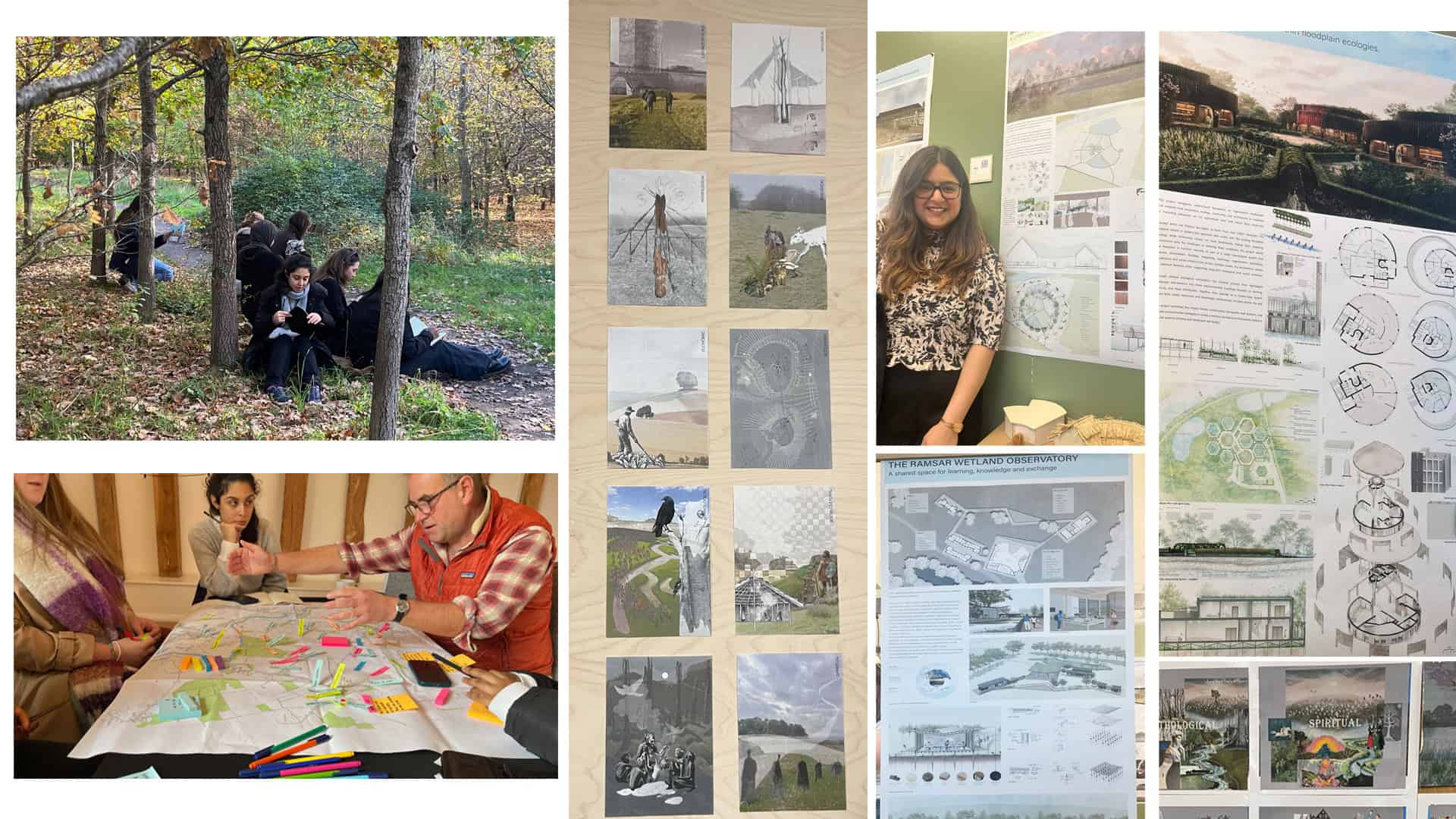
This past year our Director Helen was asked to help with a few sessions for the MA Regenerative Architecture students at the Oxford School of Architecture (Oxford Brookes), working alongside Senior Lecturer Melissa Kinnear, Peter Newton also Original of Field Architecture Director and Alex Towler also Transition by Design Director, in DS3, The Regenerative Studio. The place the students were to base their year’s project on was the Earth Trust, a place close to her heart. Using her regenerative practitioner skills, she was asked to help the students understand the place in more depth. This ranged from walking the land to sharing what she knew of the area, to bringing the students together with real local people to interview rather than the invented stakeholders a project can sometimes rely on. She attended a crit, took part in a council of all beings, and joined various feedback sessions with Simon Atkinson from the Earth Trust.
The course takes Regenesis methods as the basis for how the students learn to design, a body of regenerative development practice that begins not with form but with deeply understanding place. Storying place sits at the centre of that practice. Architects already work with context and place, but this goes deeper and slower, it is about the patient work of getting to know a place before deciding what to design for it.
Not a site. A living whole.
Conventional architecture tends to move quickly from a place to a problem to a solution: here is the site, here is the brief, let’s build the building. The Regenesis approach the students were learning slows all of that right down. The discovery stage, RIBA Stage 1, if you like becomes far deeper. Before anyone draws a line, the work is to understand the place as a living system: its ecological, social and economic patterns, and how they have shaped one another across time.
That meant treating the Earth Trust not as a plot of land waiting for an intervention, but as a whole with its own history, character and trajectory, something that is already alive and already becoming.
Getting into relationship
The process is fundamentally relational, so much of it happened in conversation and on foot.
Simon helped the students understand the organisation, its plans for the space, and the long history of the place. We walked the land repeatedly, and from every perspective, so the students could be in place rather than study it from a screen. There is a particular kind of knowing that only comes from standing somewhere, in weather, at different times, until you start to feel where a building might honestly belong.
Key local stakeholders were brought in who carry real knowledge of the place: neighbours, a working farm, the Sylva Foundation. Each holds a perspective and a sense of the boundaries and relationships of the place that no map can give you.
And a workshop was ran where knowledgeable people from the surrounding village were invited to answer questions about the place. Post-it notes went onto a large map, building up a layered picture of what has happened here over time and what people feel matters, the systems of place made visible, written in the community’s own hand.
Patterns, purpose, potential — and essence
Using the Regenesis frameworks, this gathered understanding becomes a way of reading the patterns of a place across time, and of asking what the purpose of this place is within the larger place it sits within. Where does the Earth Trust sit in that bigger system, and what is its role within it? What is its potential, not its problems to be fixed, but its latent capacity waiting to be realised?
And, crucially, what is its essence, the thing that makes this place irreducibly itself?
This is the heart of it. Only once that essence has been discovered can a truly honest dialogue with the place begin: a conversation about what it actually needs to become, rather than what we would like to impose on it.
From understanding to design
With that foundation, the students settled on an area of the Earth Trust to concentrate on and began investigating how to design regeneratively there. What materials might be used? How could a building be conceived not as an object dropped onto a site, but as something that serves the living processes of the place? What might this look like for future ancestors, for the people who will inherit the consequences of these decisions generations from now?
Halfway through the year they met Simon again to show where they had got to, presenting their thinking as a series of nine A6 postcards representing the different storying place themes with 1 that tried to capture the essence of the earth trust for each student, a lovely, modest format for ideas that were still forming.
The final shows came at the end of May: building proposals, models, and some genuinely exciting ideas. It was a real pleasure to see how far the students had travelled, not just in their designs, but in how they had come to understand place itself.
Why this matters
Regenerative development is a deeper process than conventional architecture. It is not problem-solution-build. It is a collaborative process in which all stakeholders are involved, oriented towards designing for evolutionary life, towards ensuring greater vitality and capacity-building in a place, so that the place itself becomes more able to generate health and value over time.
That is what storying place sets in motion. It begins not with a building, but with listening and with building relationship with a place and the people who hold it, towards greater capacity and vitality for all who are part of that process.
Helen was inspiring to be involved on this journey with the students, and she looks forward to seeing the difference they can make to architecture, designing buildings that represent and hold space for all life, not just human life. If this is the next generation of architects, the places they shape are in thoughtful hands.