The Circular Hub: Designing an Exhibition as a Reusable Resource
Exhibitions are, by nature, temporary. Too often, that temporariness is treated as permission for disposability, materials specified for speed, stands designed for a single use, and valuable resources written off at the end of a show.
At Nested Living, we see this as a missed opportunity.
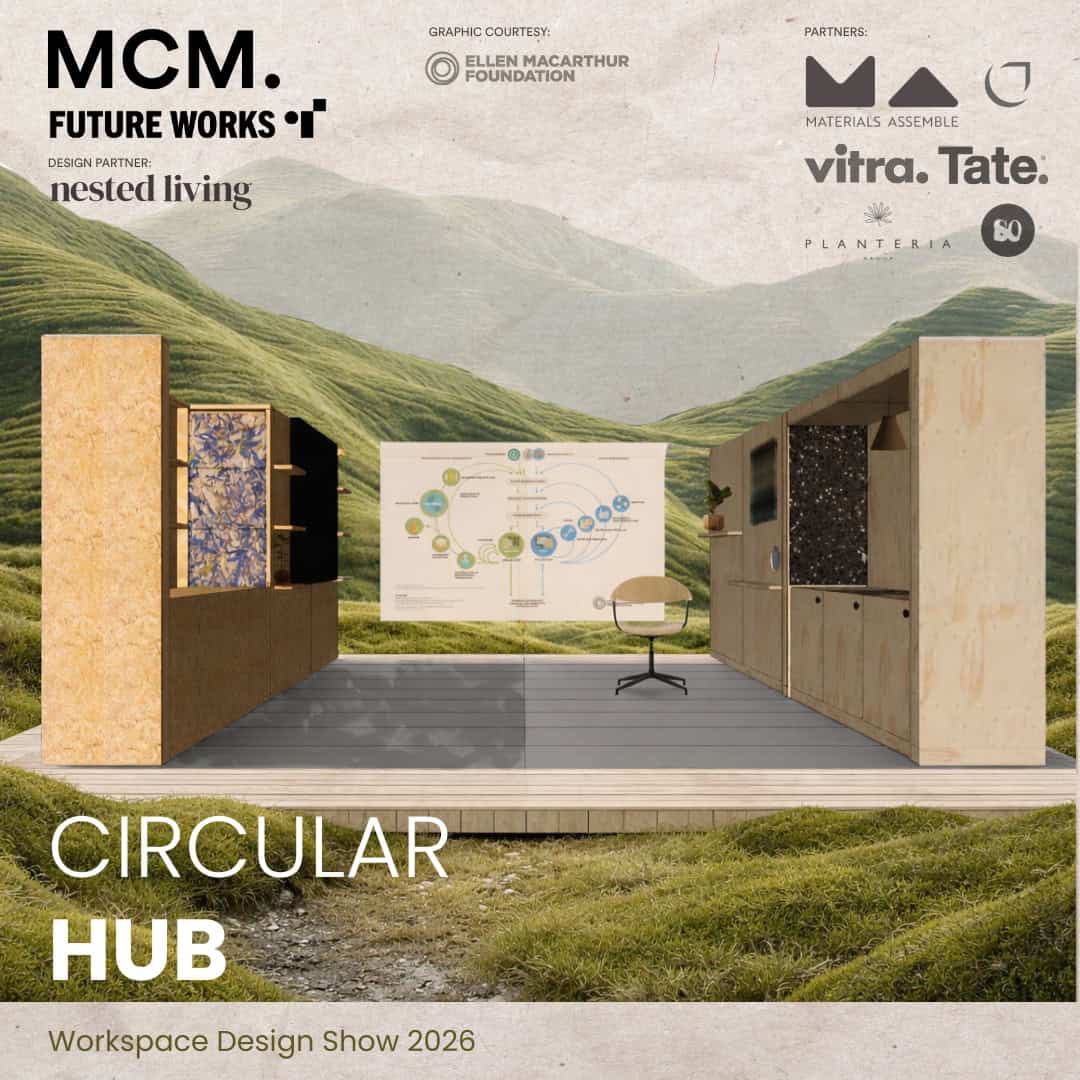
Presented as part of the Workspace Design Show (25–26 February) The Circular Hub was conceived as an alternative: an exhibition designed as a reusable resource, not a one-off installation. Created in partnership with MCM and Future Works, the hub brings circular principles into physical, practical form allowing visitors to see and understand how structures and products are designed to be dismantled, reconfigured, and reused.
From stand to system
Rather than treating the stand as a finished object, we approached it as a working prototype. Every design decision from structure to fixings was guided by a simple question: how might this exist beyond the exhibition itself?
The result is a modular timber frame construction, assembled entirely using mechanical fixings. This allows the stand to be cleanly dismantled, reconfigured, reused, or recovered without material degradation. No glues, no irreversible bonds just thoughtful detailing that prioritises adaptability and future use.
In this way, the stand itself becomes part of the learning experience: a demonstration of how circular thinking can be embedded into construction from the outset.
Raw and resource: revealing circular pathways
The Circular Hub is organised around two contrasting wall conditions, each revealing a different relationship to material use.
The resource wall demonstrates a sustainably sourced approach. Spruce plywood is mechanically fixed for future recovery, paired with natural fibre insulation designed for clean separation. This side of the stand speaks to longevity, renewability, and the careful stewardship of materials.
In contrast, the raw construction wall exposes standard building materials, including OSB fixed to the same modular timber frame. By showing these materials honestly and without disguise, the wall invites questions about typical construction practices and how even commonplace materials can be specified and assembled more responsibly.
Placed side by side, the two walls trace materials from raw to refined, revealing different circular pathways rather than prescribing a single solution.
Collaboration as circular practice
Circularity is not just a material challenge, it is a collaborative one. The Circular Hub brings together a diverse group of partners, including Materials Assemble Gencork Tate Vitra. Planteria and Studio Omelette.
Together, these contributions demonstrate how circular principles apply across interior design, furniture, materials, and spatial experience showing that progress depends not on isolated innovations, but on shared intent and purposeful collaboration.
The graphic language of the space, developed with support from the Ellen Macarthur Foundation further grounds the hub within a wider circular economy context.
Learning through making (and unmaking)
Central to the Circular Hub is participation. The space hosts a programme of events and challenges that invite visitors to dismantle and rebuild a piece of furniture, putting adaptability, repair, and reuse into practice.