How Local Actions Create Wider Ripples: Reflections on the RSA Oxford City Conversation on Regeneration
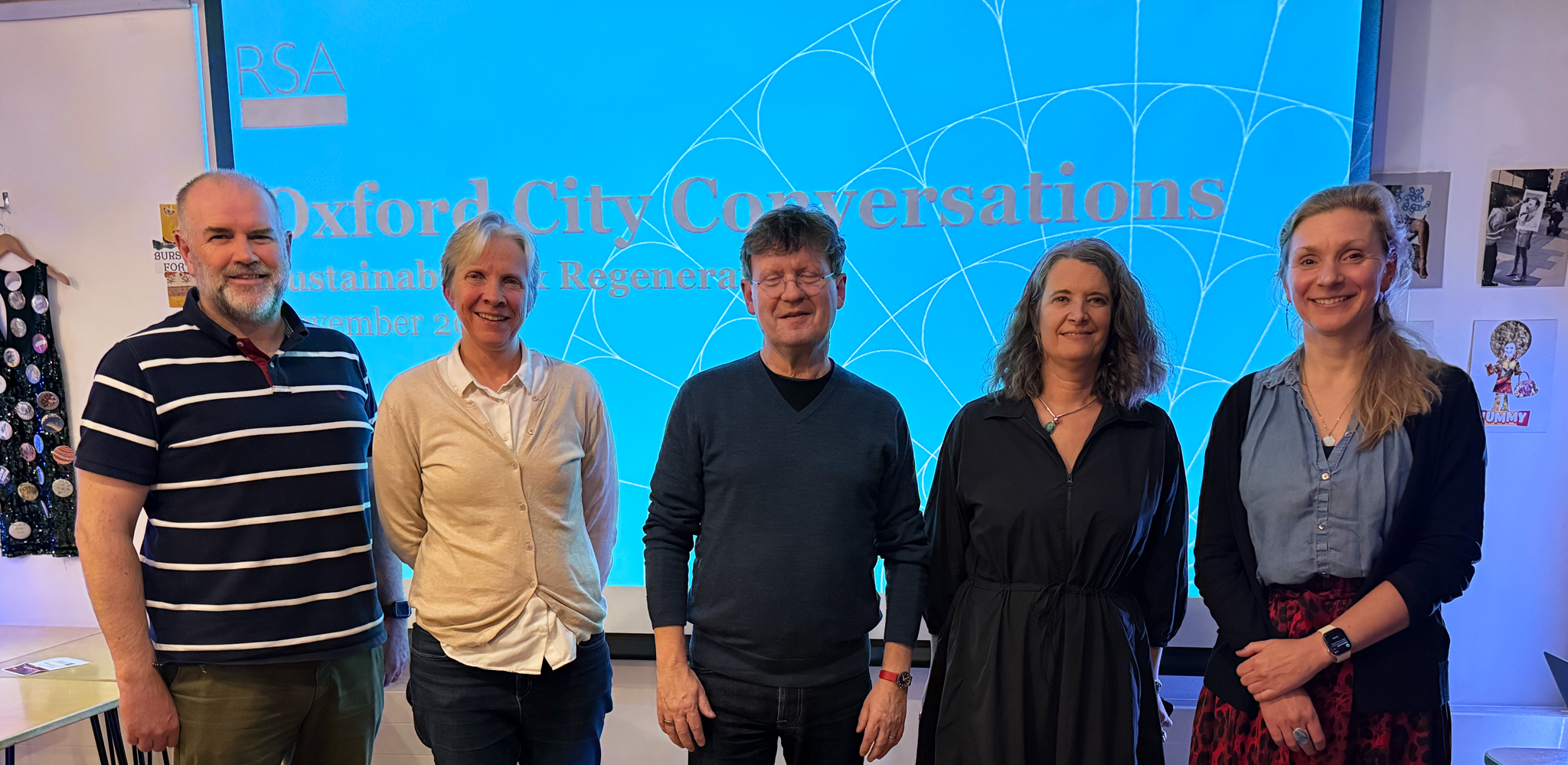
Last week, Helen Gordon, regenerative designer and co-founder of Nested Living, hosted the third RSA Oxford City Conversation, this time exploring Sustainability & Regeneration through the lens of Oxfordshire.
The event’s framing drew on the RSA’s Design for Life mission, which focuses on strengthening the capabilities, relationships and systems that help people and places flourish in harmony. Helen shaped the evening around this mission, creating a space to explore regeneration not as abstract theory, but as a way of understanding place, potential and community.
Why these conversations matter
Oxfordshire is a county of remarkable creativity and global influence, but also one of the most unequal and ecologically depleted in England. Holding these realities together highlights why conversations about regeneration and the transformative potential of place-based action are urgently needed.
Beyond sustainability
Sustainability has helped society reduce harm for decades.
But regeneration asks a deeper question:
How do we enable the long-term vitality of people, places and ecosystems?
The evening invited attendees to explore this shift, recognising that regeneration is ultimately about relationships between people, communities and the wider living systems they are part of.
Three provocations
Helen invited three RSA Fellows whose work offers grounded examples of regeneration in practice:
Sarah Jordan
Founder and CEO of Y.O.U Underwear, Sarah shared how witnessing the impact of underwear poverty on girls’ education in Uganda led her to create an Oxford-based ethical fashion brand rooted in Fairtrade materials, circularity and empowerment.
Her story highlighted regeneration as a social and economic force strengthening dignity and opportunity.
Mark Luntley
Mark’s work in community-owned renewable energy illustrated the power of citizen agency. From Westmill Wind Farm to leading REScoop Europe, he showed how small cooperatives can grow into networks capable of reshaping energy systems across the continent.
Melissa Kinnear
An architect and lecturer at Oxford Brookes University, she specialises in regenerative development and shared her work with Architecture Sans Frontiers and the impact it has had globally to the regenerative development work locally in Oxfordshire where she invited the room to see Oxfordshire as part of the larger Thames Bioregion, a living system where biodiversity, design and human wellbeing are inseparable.
A shared regenerative pattern
Despite their different fields, all three speakers illuminated the same principle:
Meaningful change often begins with grounded, local action, small interventions that create wider ripples through relationships, collaboration and shared purpose.
This echoes a core regenerative idea: nodal intervention, the notion that well-placed actions can unlock much larger systemic potential.
Why this was an inspiring conversation
Helen designed the evening to help the room notice patterns beneath the stories, and to begin imagining Oxfordshire not only as a place of challenges, but as a place of possibilities.
What emerged was a picture of a county rich in potential where citizen action, enterprise, ecological awareness and community ownership can strengthen the fabric of place over time.
And, as the speakers demonstrated, the ripples that begin in Oxfordshire often extend far beyond it not through exporting solutions, but through relationships, collaboration and example.
The evening reinforced a simple truth: the ripples begin with people and they begin here.